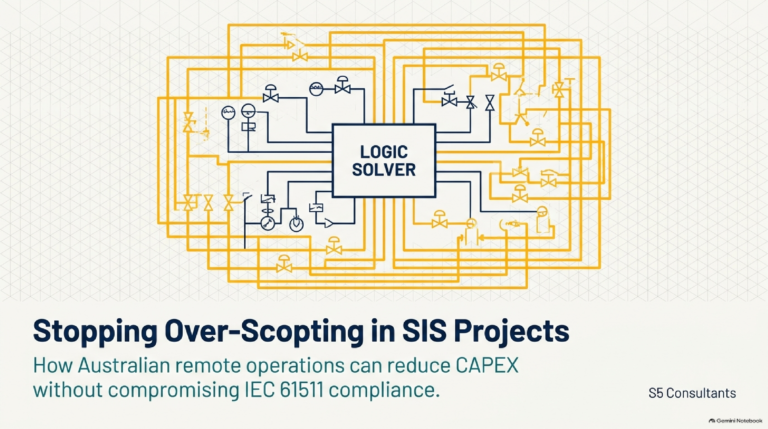
Stop Over-Scoping Your SIS: Applying Defensible Logic to LOPA
Every hazard review seems to end the same way: another independent protection layer tacked onto
the Safety Instrumented System to satisfy an overly conservative risk matrix. The LOPA process is
supposed to prevent exactly that, yet it is the process most often used to justify the layer
rather than challenge it.
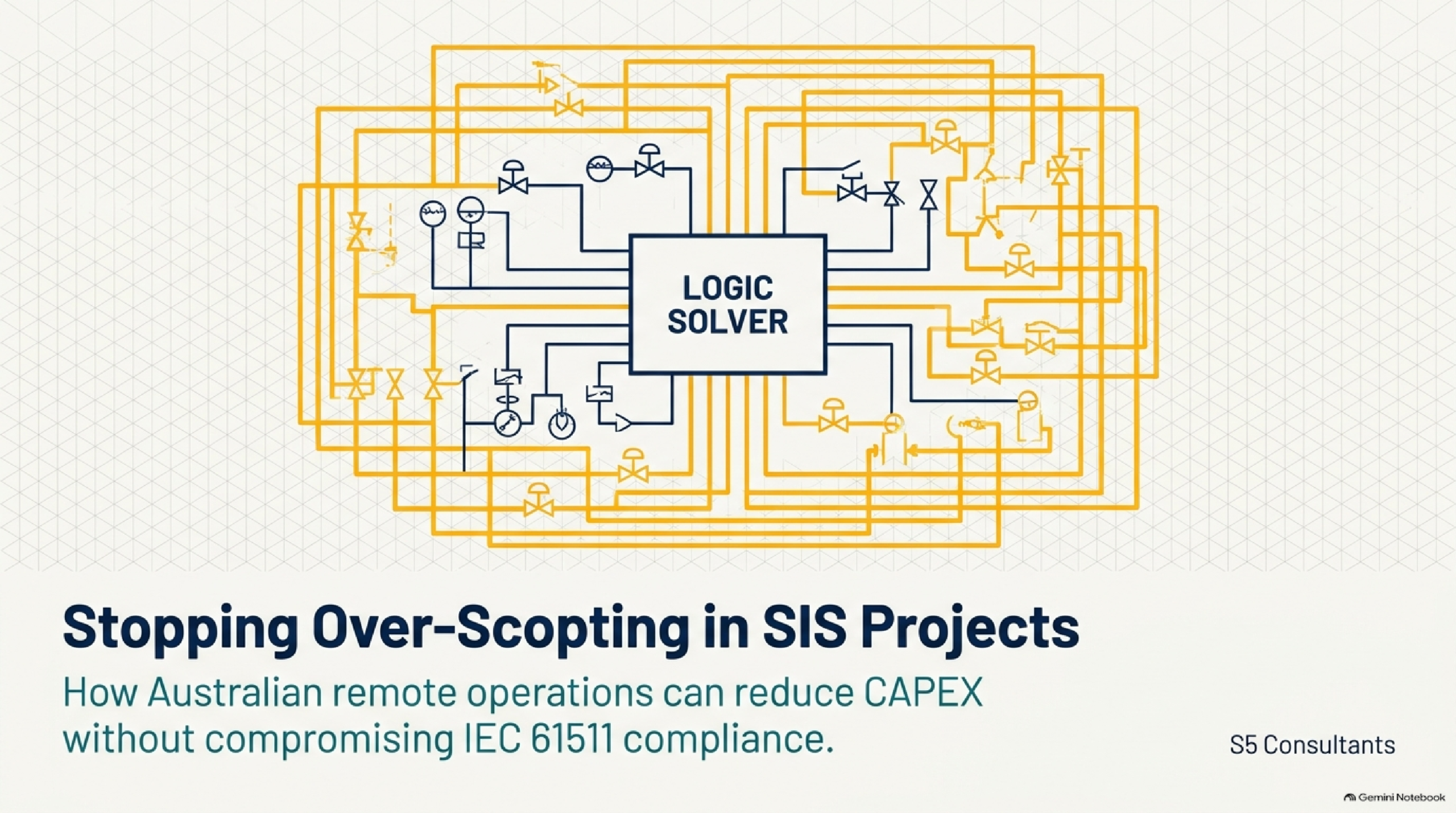
Safety engineers are trapped in the escalating cycle because standard checklists and tick-box
compliance lack the nuance to question historical assumptions. Each review adds a layer; almost
none removes one.
Why adding layers makes a plant less safe
Over-scoping is not a conservative choice. It is an active risk:
- Capital. Every additional protection layer is hardware, I/O, cabinet space,
engineering hours and long-lead procurement. - Proof testing. Each trip function carries a test interval, a test procedure
and a cost that recurs every year of the plant’s life. - Operator attention. More trip functions means more nuisance trips and more
alarms. Alarm floods hide the genuine threats behind a wall of noise — the failure mode the
extra layer was supposed to prevent.
What a defensible LOPA looks like
The purpose of LOPA is not to justify a protective layer. It is to test whether the layer is
genuinely independent, genuinely reliable, and genuinely necessary. In practice that means
challenging the inputs rather than inheriting them:
- Validate the initiating event frequency. Assumptions are often inherited
from a generic database and never re-checked against actual site experience and maintenance
records. - Interrogate every claimed independent protection layer. Independence is a
physical and functional claim, not a paperwork claim. Shared sensors, shared logic solvers, shared
final elements and shared utility supplies all defeat it. - Credit what credit is due. Operator response, mechanical relief and
independent high-integrity systems are routinely under-credited in over-conservative reviews. - Document the argument. A layer that cannot be defended to an auditor with
evidence will be re-litigated at the next LOPA workshop.
The measurable outcome
- Up to thirty per cent fewer spurious trips.
- A significant reduction in annual proof-testing hours.
- A cleaner control room, where critical alarms are actually noticed.
A leaner, more effective safety architecture does not mean less protection. It means protection
allocated where the risk actually is.
Where to get an independent view
S5 Consultants provides functional safety engineering across
SIL determination, LOPA facilitation,
safety requirements specification and verification, alongside
wider engineering services.
Cross-published from the S5 Consultants LinkedIn stream. Follow us on
LinkedIn for the original post.
Talk to S5 Consultants
S5 Consultants is the assurance arm of S5 — functional safety, OT cybersecurity,
SCADA and systems engineering for industrial operators.
Read more on our services or
functional safety.
Discuss your project —
book a call.
Need a defensible functional-safety position?
Independent IEC 61511 consultancy — HAZOP, LOPA and SIL assessment, SIS design review and operational readiness. Led by a Certified Functional Safety Expert.
Fixed-scope engagement, clear deliverable, no obligation.