Closing the Field to Office Data Gap on Industrial Sites
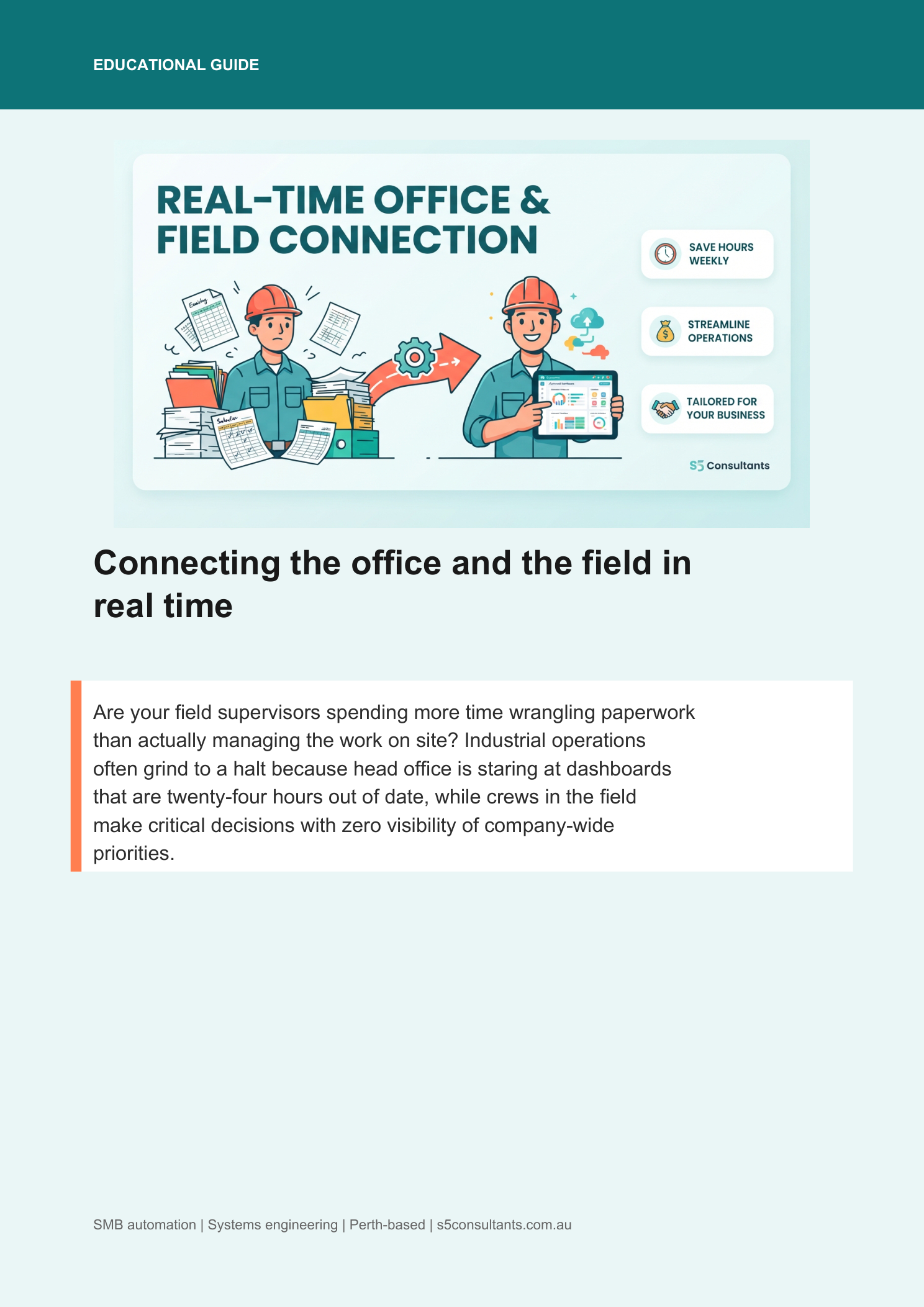
Ask a field supervisor where the data goes and the answer is usually a shrug. Field to office
data flow is the difference between a decision made on today’s reality and one made on yesterday’s
spreadsheet — and on most industrial sites, head office is staring at dashboards that are
twenty-four hours out of date while crews on site make critical decisions with no visibility of
company-wide priorities.
The cost of the gap, per week
- Rework caused by decisions made against stale information.
- Idle machinery and wasted labour hours waiting on a plan that has already changed.
- Supervisors chasing paper dockets and phone calls instead of managing the work.
- Safety exposure, because the current state of the site is not visible to the people
accountable for it.
None of these show up as a line item. All of them show up as a bad month.
Why off-the-shelf tools widen the gap
Generic enterprise software and DIY spreadsheets share the same root assumption: that the
office and the field are separate systems to be reconciled by people. The tooling then adds
administrative weight — a new form to complete, a new app to learn — and the crews
quietly stop using it. Within a quarter the spreadsheet is back and the dashboard is
decorative.
What a working field to office data bridge looks like
- Capture at the point of work. If entry takes longer than the task it
describes, it will not happen. The tool has to fit the workflow of somebody wearing a hi-vis vest,
in gloves, in the sun. - Reconcile automatically. Field progress, plant data and the planning system
converge into one status, not three. - Expose a single source of truth. Leadership sees the same numbers as the
crew, in near real time, without a manual report being compiled first. - No new internal IT function. If the solution requires the site to run and
maintain a platform, it will be deprioritised the first busy week.
This is integration work rather than application work: connecting what the field records to
what the office decides, without adding a screen in between.
The outcome
- Reporting turnaround cut by around seventy per cent.
- Administrative overhead roughly halved.
- Leadership working from a single source of truth, in real time.
Where this sits in S5 Consultants’ work
Field to office data integration is the operations-automation side of our
engineering and systems work. It often
starts next to the plant data problem described in
AI and automation, and shares its architecture
with our OT cybersecurity work: the
same boundary that lets data out has to keep threats out.
Cross-published from the S5 Consultants LinkedIn stream. Follow us on
LinkedIn for the original post.
Talk to S5 Consultants
S5 Consultants is the assurance arm of S5 — functional safety, OT cybersecurity,
SCADA and systems engineering for industrial operators.
Read more on our services or
functional safety.
Discuss your project —
book a call.
Need a defensible functional-safety position?
Independent IEC 61511 consultancy — HAZOP, LOPA and SIL assessment, SIS design review and operational readiness. Led by a Certified Functional Safety Expert.
Fixed-scope engagement, clear deliverable, no obligation.